

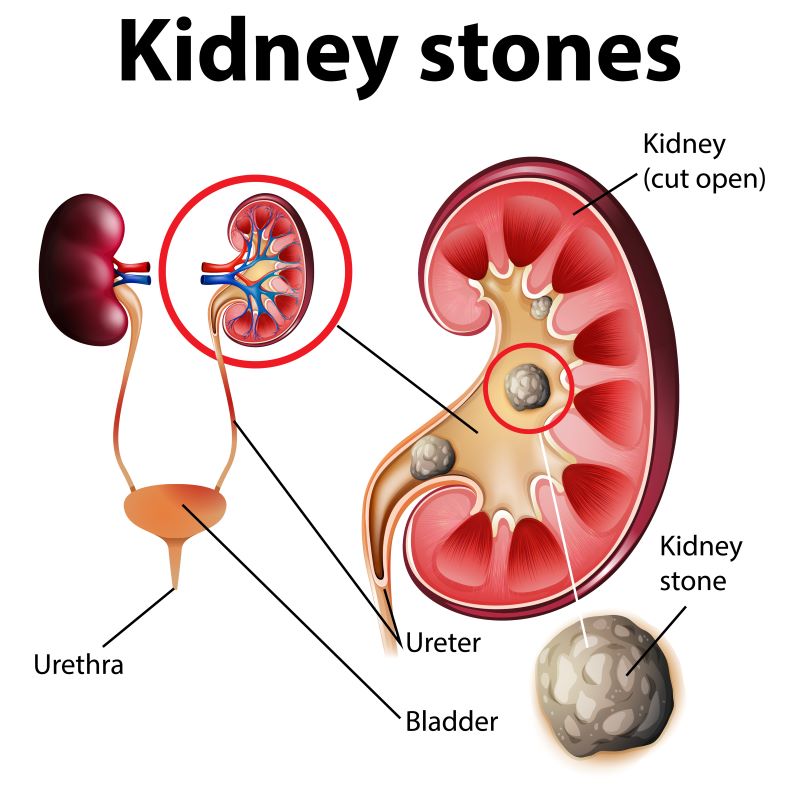
Kidney stones are very common. They are formed within the kidneys and come in different shapes and sizes. Kidney stone usually becomes symptomatic when it enters the ureter (a long but narrow tube that connects a kidney to the bladder) and causes a blockage or obstruction. The presence of the stone itself does not typically cause pain. Pain results if and when a stone blocks the natural flow of urine from the kidney to the bladder. The pain is often very sharp and severe and can be associated with nausea and vomiting.
Most kidney stones are calcium based and there are many reasons for their formation. Some common risk factors include obesity, diabetes, high dietary salt intake, diet rich in oxalates (such as soda pop, tea, coffee) and red meat, deficiency of water intake and decreased consumption of fruits and vegetables. Some stones can also form from certain medications, recurrent urinary tract infections and hereditary factors.
Kidney stones are well known to be very painful. There are, however, other symptoms that may occur as well:
Diagnosis of a kidney stone is typically made with imaging such as a CT scan or a kidney Ultrasound. CT scan is generally more sensitive and reliable in detecting a stone than an Ultrasound is.
MRI scans are not routinely used to diagnose stones because stones are not typically seen on MRIs.
Additional tests, such as blood and urine, are often performed to evaluate kidney function and rule out a possible concomitant urinary tract infection.
Small kidney stones may pass on their own, but this may take a few weeks and sometimes even longer.
Stone removal, or at least a temporary decompression of the obstructed kidney, will generally be recommended in the following situations:
Most common procedure offered for kidney stones is ureteroscopy and laser lithotripsy with stent insertion (using a small camera the stone is visualized and broken down using a laser fiber to small pieces and a temporary stent is inserted for healing).
Stent insertion by itself, without removing the stone, may be recommended if there is a concomitant urinary tract infection, the stone is too large, there are many stones present and/or if you are taking blood thinning medications. The purpose of the stent is to bypass the obstruction and relieve pain related to the stone. In situations where only the stent is placed, then another procedure will be necessary to remove the stone(s) in the near future.
Aside from ureteroscopy, other kidney stone treatment options include Extracorporeal Shock Wave Lithotripsy (ESWL) and Percutaneous Nephrolithotomy (PCNL).
One of the best ways to help prevent kidney stones is by staying well hydrated. In addition, lowering sodium and oxalate intake are additional ways to help reduce stone formation.
Many people who’ve had one kidney stone are prone to developing another kidney stone episode in the future.
Small stones, especially those less than 5 millimeter (mm) in size, have a higher chance of passing on their own compared to larger stones. As long as you don’t have a febrile urinary tract infection, persistent vomiting and your pain is well controlled, it is very reasonable to wait a few weeks and see if the stone passes on its own. If your stone fails to pass after some time, a procedure would be recommended to remove it.
We are dedicated to compassionate and comprehensive urologic care, offering you necessary and appropriate evaluations and treatments that you may need to feel and be healthy. With years of experience in urologic care, we are the team that you can trust.
Urologic Surgery of NWI is your source of reliable information and excellent urologic care in the region. We are here to answer all of your questions and take care of you like family. Please contact us today to schedule your consultation appointment.

We will work together to jointly find the best treatment plan for you. We respect your wishes and are here to empower you to make your own decisions regarding your health and well being. Please contact our office to schedule a consultation.
Request An Appointment